
DAVID BOWIE, MIO FRATELLO
Di David Lawrence a cura di Francesco Longo
Gli scatti che raccontano l’artista attraverso lo sguardo del fratello Terry Burns
Novanta fotografie costruiscono un racconto su David Bowie che parte da una relazione privata e attraversa l’intera traiettoria pubblica dell’artista. David Bowie, mio fratello è il progetto dello scrittore David Lawrence in programma per la prima volta in Italia, dopo l’esposizione a Parigi, dal 17 aprile al 12 luglio a Musa Art Gallery, Torino.
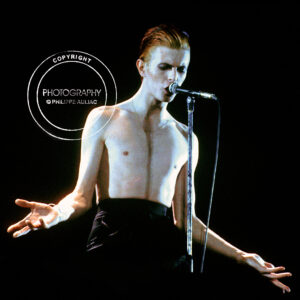
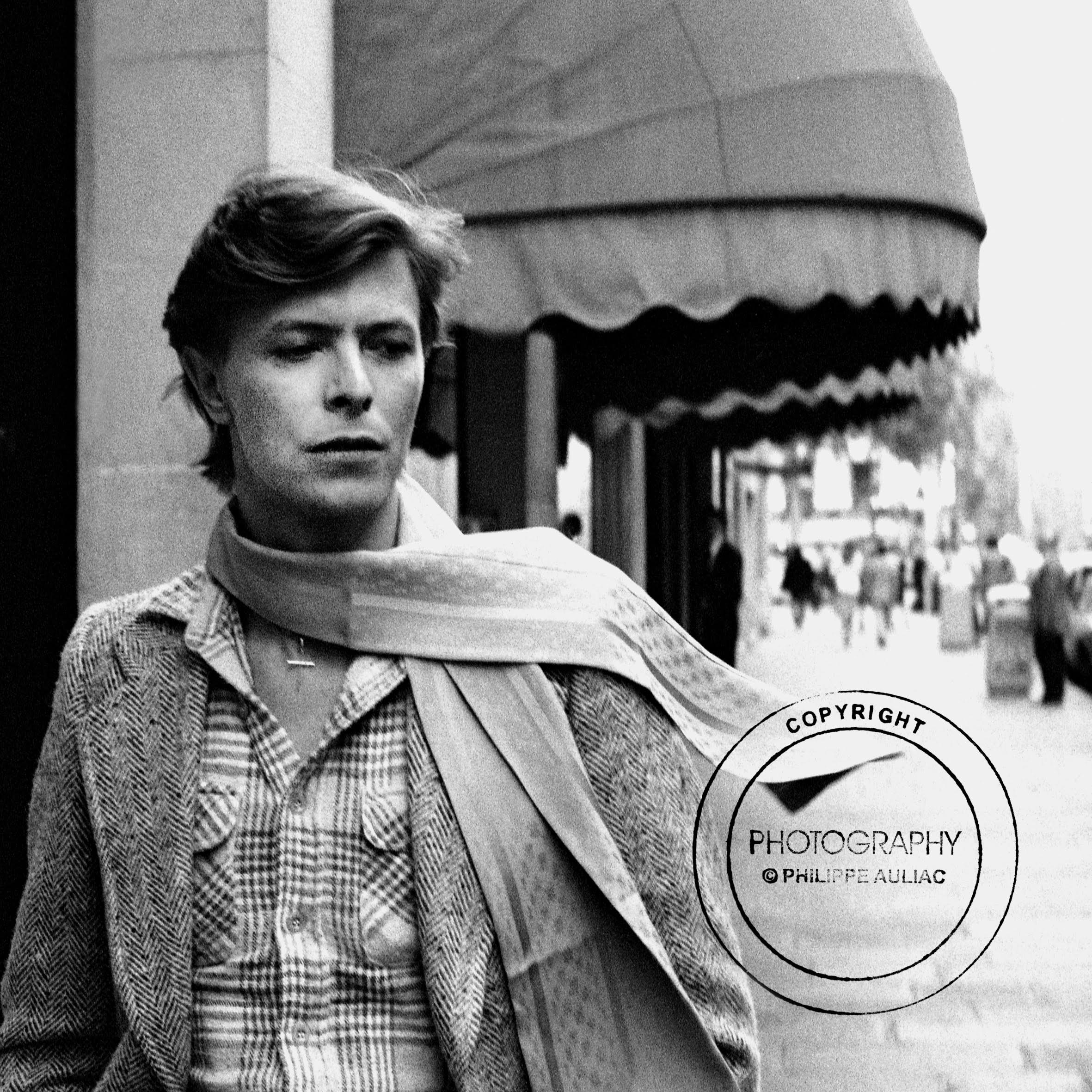
Il punto di vista è definito dall’impianto della mostra: la figura di Terry Burns, fratellastro di Bowie, diventa il dispositivo attraverso cui leggere immagini, testi e materiali. Non una retrospettiva, ma un percorso che mette in relazione episodi biografici, riferimenti culturali e costruzione dell’identità artistica. Il nucleo espositivo riunisce una rassegna di fotografie, in parte realizzate da autori che hanno seguito Bowie lungo la sua carriera – tra cui rari scatti di Denis O’Regan, Philippe Auliac e Michel Haddi – in parte provenienti da altri contesti. Le immagini non seguono una sequenza cronologica lineare, ma si organizzano per nuclei, restituendo passaggi, trasformazioni e continuità. Accanto ai ritratti di Bowie compaiono figure che ne definiscono il contesto umano e creativo: familiari, musicisti, artisti e intellettuali, i genitori, il nonno, Thomas Edward Lawrence, Miles Davis, Lou Reed, Iggy Pop, Mick Jagger, Pablo Picasso, Bob Dylan, Brian Eno, Marc Bolan, John Lennon, Elvis Presley, Lindsay Kemp, Bing Crosby, Frank Sinatra, Jimi Hendrix, Jim Morrison, William S. Burroughs, Jean Genet, Jack Kerouac, Syd Barret, Angie Barnett Bowie, Otto Mueller, tra gli altri. Il percorso costruisce così una rete di relazioni che rimanda alle influenze alla base del suo lavoro, dalla musica alla letteratura, dalle arti visive al cinema.
All’interno di questo sistema, Terry Burns assume un ruolo strutturale. È attraverso di lui che Bowie entra in contatto con una parte significativa del proprio orizzonte culturale – dalla letteratura al jazz – elementi che tornano, trasformati, nella sua produzione. La mostra utilizza questo legame come chiave di lettura, senza isolarlo in una dimensione esclusivamente biografica. Testi e immagini procedono su due livelli paralleli. La scrittura accompagna il percorso senza funzione descrittiva, costruendo un controcampo narrativo che orienta la lettura delle fotografie.
La mostra è accompagnata da due pubblicazioni, disponibili nello spazio espositivo: il catalogo David Bowie, My Brother con testi di Denis O’Regan, Philippe Auliac, Michel Haddi, Francis Huster, Martine Assouline, Rupert Wynne James (Le Caravelle) e il romanzo biografico David Bowie, My Brother di David Lawrence (Le Caravelle).
DAVID LAWRENCE
Da oltre trent’anni David Lawrence cura mostre tra Europa, Marocco e Stati Uniti. A Torino ha esposto il progetto Lettere immaginarie dedicato a Pablo Picasso. Il suo lavoro unisce scrittura e costruzione espositiva con una particolare attenzione al rapporto tra materiali documentari e narrazione. In David Bowie, mio fratello questo approccio si traduce in un progetto sviluppato nell’arco di più di un anno di ricerca. Alla base anche una componente personale: David Lawrence ha attinto ai ricordi del fratello maggiore Philippe, segnato da problemi di salute mentale, che aveva lavorato sul set de I predatori e incontrato David Bowie.
TERRY BURNS
Terence Guy Adair Burns (1937-1985), detto Terry, è il fratellastro maggiore di David Bowie. Nasce il 5 novembre 1937 da Margaret Burns e James Isaac Rosenberg, che non lo riconosce e abbandona la famiglia prima della sua nascita. Dieci anni dopo, l’8 gennaio 1947, nasce David Jones (poi David Bowie), figlio di Margaret Burns e Haywood Stenton Jones, che si sposeranno nello stesso anno. I due crescono nello stesso nucleo familiare, condividendo un rapporto che si consolida negli anni dell’adolescenza.
Figura determinante nella formazione di Bowie, Terry lo introduce alla letteratura, al jazz e a un ampio orizzonte culturale che include autori come Jack Kerouac, Francis Scott Fitzgerald, William S. Burroughs, John Steinbeck, William Shakespeare, Ernest Hemingway e Jean Genet. Questo patrimonio di riferimenti incide in modo duraturo sul suo immaginario artistico.
Il loro legame è segnato anche dalla malattia mentale di Terry, la schizofrenia, diagnosticata nei primi anni Sessanta e dai successivi ricoveri al Cane Hill Hospital. A questa esperienza Bowie fa riferimento diretto nel brano All the Madmen. Il 16 gennaio 1985 Terry muore suicida. La sua figura resta tuttavia un riferimento costante nell’opera di Bowie: il videoclip Jump They Say (1993), così come gli album Hours (1999) e Heathen (2002), ne restituiscono tracce esplicite.
All’interno della mostra David Bowie, mio fratello, è la voce di Terry Burns a orientare il percorso, offrendo una chiave di lettura che tiene insieme dimensione familiare e costruzione artistica.
Intro di Francesco Longo
Quando avevo quattordici anni trovai due audiocassette. Una era di David Bowie, l’altra di Neil Young. Ricordo ancora il gesto semplice, quasi distratto, con cui le inserii nel mangianastri: da una parte una voce che sembrava provenire dalla terra, dall’altra un suono che pareva arrivare da un altrove indefinibile. Mi appassionai subito a Bowie. Non era soltanto musica: era una presenza, un attraversamento.
Qualche tempo dopo andai a vedere Furyo al cinema, in anteprima. Rimasi colpito dal suo silenzio, dalla capacità di occupare lo spazio anche senza parole. Più tardi lo vidi dal vivo, durante il Glass Spider Tour. Fu allora che compresi davvero cosa significasse trasformarsi: non cambiare forma, ma moltiplicarla. Decisi persino di andare a Losanna, in Svizzera, dove viveva. Non accadde mai. Ma forse, in qualche modo, quel viaggio non compiuto è rimasto il più fedele alla sua essenza: Bowie non si raggiunge, si insegue.
È stato uno dei miei autori più importanti. Trasformista, certo, ma anche trasportatore di tempi, linguaggi e visioni. Ha attraversato la moda, l’arte, la musica, dialogando con le tensioni della pop art e con l’eco di un’epoca in cui tutto sembrava possibile e reversibile. Non ha mai smesso di interrogare l’immagine, di smontarla e ricomporla, come se ogni identità fosse solo una tappa provvisoria.
Questa mostra nasce da quella traiettoria personale e collettiva. Progettata dallo scrittore David Lawrence, si sviluppa come un percorso non solo visivo, ma anche narrativo e poetico, seguendo una linea di pensiero intima e laterale, ispirata alla figura di Terry, il fratello di Bowie, presenza fragile e determinante nella sua formazione emotiva e artistica. È proprio in questa dimensione più nascosta che si apre uno spazio nuovo: un Bowie meno iconico e più umano, meno costruito e più vulnerabile.
Le fotografie qui raccolte, firmate da alcuni dei più grandi autori della scena internazionale, non documentano semplicemente un volto o un’epoca. Costruiscono un racconto stratificato, in cui ogni immagine è una soglia. Bowie appare e scompare, si offre e si sottrae, come se ogni scatto fosse solo una possibile versione tra le infinite che ha incarnato.
Come direttore artistico di Musa Art Gallery, ho scelto di presentare questo progetto perché incarna perfettamente quella tensione trasformista che ha reso Bowie una figura unica. Non una celebrazione nostalgica, ma un’esperienza immersiva e contemporanea, capace di restituire la complessità di un artista che ha ridefinito i confini della cultura pop.
A dieci anni dalla sua scomparsa, questa mostra non intende chiudere un discorso, ma riaprirlo. Bowie continua a parlarci, non come memoria, ma come possibilità. Un invito a cambiare pelle, ancora una volta.
Francesco Longo
Intro by Francesco Longo
When I was fourteen, I found two audio cassettes. One was by David Bowie, the other by Neil Young. I still remember the simple, almost absent-minded gesture with which I placed them into the tape recorder: on one side a voice that seemed to come from the earth, on the other a sound that felt as if it came from an undefined elsewhere. I was immediately drawn to Bowie. It wasn’t just music—it was a presence, a passage.
Some time later, I went to see Furyo at the cinema, at its premiere. I was struck by his silence, by his ability to occupy space even without words. Later, I saw him live during the Glass Spider Tour. It was then that I truly understood what transformation meant: not changing form, but multiplying it. I even decided to go to Lausanne, in Switzerland, where he lived. It never happened. But perhaps, in some way, that unfulfilled journey remained the most faithful to his essence: Bowie is not reached, he is pursued.
He has been one of my most important artistic references. A shapeshifter, certainly, but also a carrier of time, language, and vision. He moved through fashion, art, and music, engaging with the tensions of pop art and the echoes of an era in which everything seemed possible and reversible. He never stopped questioning the image, deconstructing and recomposing it, as if every identity were only a temporary stage.
This exhibition emerges from that personal and collective trajectory. Conceived by the writer David Lawrence, it unfolds as a path that is not only visual, but also narrative and poetic, following an intimate and lateral line of thought inspired by the figure of Terry, Bowie’s brother—a fragile yet decisive presence in his emotional and artistic formation. It is precisely within this more hidden dimension that a new space opens up: a Bowie who is less iconic and more human, less constructed and more vulnerable.
The photographs presented here, created by some of the most renowned artists on the international scene, do not simply document a face or an era. They build a layered narrative, in which each image becomes a threshold. Bowie appears and disappears, reveals and withdraws, as if every shot were only one possible version among the countless ones he embodied.
As Artistic Director of Musa Art Gallery, I chose to present this project because it fully embodies that transformative tension which made Bowie such a unique figure. Not a nostalgic celebration, but an immersive and contemporary experience, capable of conveying the complexity of an artist who redefined the boundaries of popular culture.
Ten years after his passing, this exhibition does not seek to close a conversation, but to reopen it. Bowie continues to speak to us—not as memory, but as possibility. An invitation to change skin, once again.
Francesco Longo
By David Lawrence and curated by Francesco Longo
Photographs that tell the story of the artist through the eyes of his brother Terry Burns.
Ninety photographs construct a narrative about David Bowie that begins with a private relationship and spans the artist’s entire public trajectory. David Bowie, My Brother is a project by writer David Lawrence, presented for the first time in Italy—after its exhibition in Paris—from April 17 to July 12 at Musa Art Gallery in Turin.
The perspective is defined by the exhibition’s structure: the figure of Terry Burns, Bowie’s half-brother, becomes the lens through which images, texts, and materials are interpreted. Not a retrospective, but a journey that connects biographical episodes, cultural references, and the construction of artistic identity. The exhibition brings together a review of photographs, some taken by photographers who followed Bowie throughout his career—including rare shots by Denis O’Regan, Philippe Auliac, and Michel Haddi—and others drawn from different contexts. The images do not follow a linear chronological sequence, but are organized into thematic clusters, conveying transitions, transformations, and continuities. Alongside portraits of Bowie appear figures who define his human and creative context: family members, musicians, artists, and intellectuals—his parents, his grandfather, Thomas Edward Lawrence, Miles Davis, Lou Reed, Iggy Pop, Mick Jagger, Pablo Picasso, Bob Dylan, Brian Eno, Marc Bolan, John Lennon, Elvis Presley, Lindsay Kemp, Bing Crosby, Frank Sinatra, Jimi Hendrix, Jim Morrison, William S. Burroughs, Jean Genet, Jack Kerouac, Syd Barrett, Angie Barnett Bowie, Otto Mueller, among others. In this way, the exhibition builds a network of relationships that points to the influences underlying his work, from music to literature, from visual arts to cinema.
Within this system, Terry Burns takes on a structural role. It is through him that Bowie comes into contact with a significant part of his cultural horizon—from literature to jazz—elements that later reappear, transformed, in his work. The exhibition uses this relationship as a key to interpretation, without isolating it within a purely biographical dimension. Texts and images proceed on two parallel levels. The writing accompanies the exhibition without a descriptive function, constructing a narrative counterpoint that guides the reading of the photographs.
The exhibition is accompanied by two publications, available in the exhibition space: the catalogue David Bowie, My Brother with texts by Denis O’Regan, Philippe Auliac, Michel Haddi, Francis Huster, Martine Assouline, Rupert Wynne James (Le Caravelle), and the biographical novel David Bowie, My Brother by David Lawrence (Le Caravelle).
DAVID LAWRENCE
For over thirty years, David Lawrence has curated exhibitions across Europe, Morocco, and the United States. In Turin he presented the project Lettere immaginarie dedicated to Pablo Picasso. His work combines writing and exhibition-making, with particular attention to the relationship between documentary materials and narrative. In David Bowie, My Brother, this approach takes shape in a project developed over more than a year of research. It also draws on a personal dimension: David Lawrence has drawn on the memories of his older brother Philippe, who struggled with mental health issues and had worked on the set of Raiders of the Lost Ark, where he met David Bowie.
TERRY BURNS
Terence Guy Adair Burns (1937–1985), known as Terry, was David Bowie’s older half-brother. He was born on November 5, 1937, to Margaret Burns and James Isaac Rosenberg, who did not acknowledge him and left the family before his birth. Ten years later, on January 8, 1947, David Jones (later David Bowie) was born, the son of Margaret Burns and Haywood Stenton Jones, who married that same year. The two grew up in the same household, developing a bond that strengthened during adolescence.
A decisive figure in Bowie’s formation, Terry introduced him to literature, jazz, and a broad cultural horizon that included authors such as Jack Kerouac, F. Scott Fitzgerald, William S. Burroughs, John Steinbeck, William Shakespeare, Ernest Hemingway, and Jean Genet. This body of references had a lasting impact on Bowie’s artistic imagination.
Their relationship was also marked by Terry’s mental illness—schizophrenia—diagnosed in the early 1960s, and by his subsequent hospitalizations at Cane Hill Hospital. Bowie refers directly to this experience in the song All the Madmen. On January 16, 1965, Terry died by suicide. His figure, however, remains a constant reference in Bowie’s work: the music video Jump They Say (1993), as well as the albums Hours (1999) and Heathen (2002), contain explicit traces of him.
Within the exhibition David Bowie, My Brother, it is Terry Burns’s voice that guides the journey, offering an interpretive key that brings together the family dimension and artistic construction.